Back
Budgeting for a baby in New Zealand: Costs, leave and a first-year plan
Budgeting for a baby helps you prepare for first-year costs, parental leave, childcare and the everyday baby expenses that can quickly reshape your household budget. This guide explains what having a baby may cost in New Zealand, what support could be available and how to build a realistic baby budget before your little one arrives.
Why budgeting for a baby is essential before you go on parental leave
Budgeting for a baby before parental leave gives you time to plan for five financial changes: upfront baby essentials, ongoing monthly costs, reduced income, childcare and government support. You do not need every dollar figured out today. You simply need a clear view of what will change, what matters most and where you have room to adjust.
Start by comparing your expected income during leave with your usual household income. Then add the baby expenses you expect before and after the birth. The difference is your parental leave income gap, and spotting it early gives you more time to save, reduce bills or rethink your return-to-work date.
Baby Budget Template
Use MyBudget’s free Personal Budget Template to list your household income, bills, savings goals and expected baby costs in one place. A practical baby budget planner makes it easier to test different parental leave and childcare scenarios.
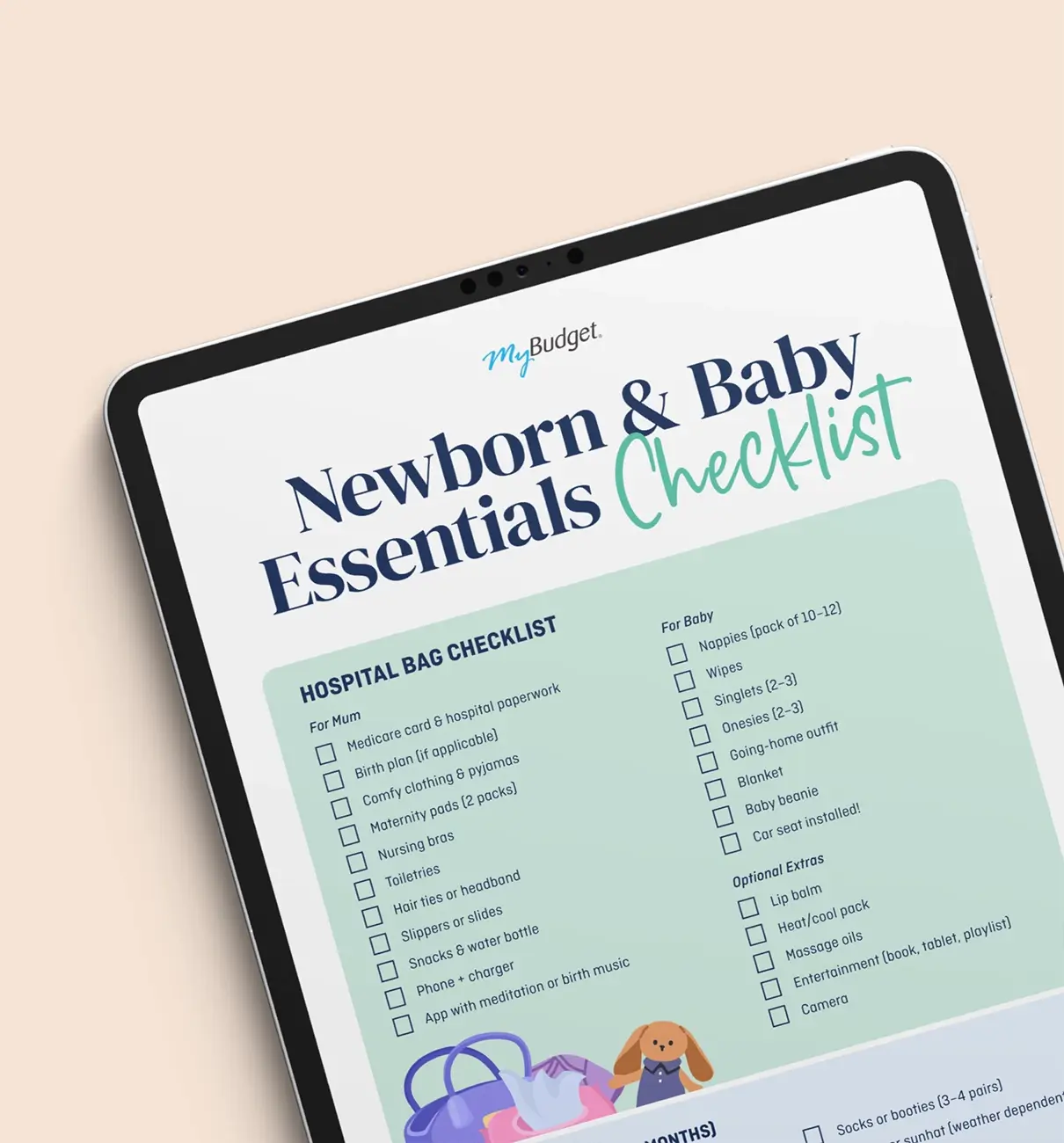
Essential Baby Checklist
Our free Newborn & Baby Essentials Checklist helps you separate genuine baby essentials from the nice-to-haves. Download it before you shop so you can plan purchases, organise group gifts and avoid doubling up.

What is the cost of having a baby in New Zealand?
The cost of having a baby in New Zealand varies with childcare, feeding choices, what you buy new and how much household income changes during parental leave. Whānau Āwhina Plunket’s 2026 guide estimates a moderate baby budget at about NZ$390 a week, or NZ$20,280 a year, and a higher-spend budget at about NZ$625 a week, or NZ$32,500 a year. These examples include childcare, usually the largest first-year expense, but not income lost while on leave.
Your total may be lower if you use publicly funded maternity care, receive hand-me-downs, breastfeed or have whānau helping with care. It may be higher if you choose private obstetric care, premium baby gear, formula feeding or full-time childcare. Use the figures as planning guides, not a quote.
Can I afford a baby? The real financial impact
You may be able to afford a baby even if the first-year figures feel daunting. The best answer comes from looking at cash flow, not a single national average.
Plan the five changes that will have the biggest effect on your finances:
- Upfront costs for a child restraint, pram, cot, feeding equipment and other baby essentials.
- Ongoing baby expenses such as nappies, wipes, formula or baby food, clothing and healthcare.
- The income gap between your usual pay and parental leave payments.
- Childcare costs after any 20 Hours ECE or Childcare Subsidy support.
- Working for Families payments and other government support you may qualify for.
Once these figures are in your budget, you can see whether you need a larger savings balance, a slower shopping plan, help from whānau or a different return-to-work date.
What upfront baby expenses should you prepare for?
Upfront baby expenses usually include safe sleeping equipment, a child restraint, a pram or buggy, feeding supplies, nappies, clothing and basic healthcare items. Buy for safety and usefulness first, then add convenience items if they fit your baby budget.
For products where history matters, especially child restraints and cot mattresses, new may be the safer choice. Check current NZ safety requirements and recall notices before using second-hand baby gear.

How much do essential baby items cost?
Current New Zealand retail prices vary by brand, sale period and whether you buy new or second-hand. These NZD ranges are a practical guide based on listings from Baby Factory and other major New Zealand baby retailers.
| Baby essential | Guide price (NZD) | Planning note |
| Child restraint or infant capsule | NZ$200-NZ$900+ | Confirm it meets an approved standard and suits your vehicle. |
| Pram, buggy or stroller | NZ$250-NZ$1,500+ | Travel systems and premium models can cost more. |
| Cot and mattress | NZ$300-NZ$1,300+ | Choose a firm, well-fitting mattress and check cot safety guidance. |
| Feeding setup | NZ$50-NZ$600+ | Depends on breastfeeding, expressing, bottles and sterilising equipment. |
| Nappies and baby-care starter supplies | NZ$100-NZ$250 | Include wipes, creams, a change mat and a small first supply. |
| Clothing and basic linen | NZ$150-NZ$400 | Buy a limited number in each newborn size. |
| Monitor, changing and nursery extras | NZ$150-NZ$1,000+ | Treat these as optional until you know what you need. |
Plunket’s 2026 guide puts bedtime supplies at about NZ$1,600 upfront and a car seat, stroller and carrier at about NZ$1,750 combined on an average-spend budget. Sales, borrowing suitable items and using Trade Me or Facebook Marketplace can reduce the total.
What are ongoing baby expenses? Monthly costs to include in your baby budget
Ongoing baby expenses can include nappies and wipes, feeding, clothing, pharmacy items, transport and childcare. Plunket estimates nappies, wipes and creams at about NZ$1,875 a year, or roughly NZ$156 a month, and food and nutrition at about NZ$1,650 a year, or roughly NZ$138 a month.
| Expense | Monthly planning guide (NZD) | What changes the cost |
| Nappies, wipes and creams | About NZ$156 | Brand, reusable nappies, age and buying in bulk. |
| Feeding and baby food | About NZ$138 | Breastfeeding, expressing, formula brand and when solids begin. |
| Clothing and linen | NZ$30-NZ$100 | Growth spurts, seasons, gifts and hand-me-downs. |
| Pharmacy and healthcare extras | NZ$20-NZ$100+ | Eligibility, appointments and optional products. |
| Transport and household costs | NZ$40-NZ$160+ | Fuel, power, laundry and extra trips. |
| Childcare | About NZ$1,333 average | Hours, age, provider, location and assistance. |
We used Baby Factory product categories and price ranges to estimate upfront baby costs. These are indicative only, not official prices or averages – check current pricing before buying.
Instead of buying smaller amounts of nappies or wipes every week, buy bigger packs, less often (somewhere like Big W or Amazon, depending on who is cheaper).
Casey | MyBudget team member
How much does childcare cost in New Zealand?
Childcare costs in New Zealand depend on your provider, location, your child’s age, the hours you need and whether you qualify for 20 Hours ECE or a Childcare Subsidy. Plunket’s 2026 guide uses an average of about NZ$16,000 a year, or roughly NZ$1,333 a month, but actual fees can be much lower or higher.
How do childcare costs vary by suburb?
Childcare fees vary by suburb because rent, staffing, opening hours, demand and the type of service differ between centres. Infant care often costs more because younger children require higher staff-to-child ratios.
Ask at least three local providers for their fee schedule, enrolment charge, minimum days, late fees, food and nappy inclusions, holiday rules and waitlist. Compare the amount you would pay after support, not only the advertised daily rate.
Children aged three to five may be eligible for up to 20 Hours ECE each week at participating services. Eligible families may also receive a Childcare Subsidy through Work and Income, generally for up to 50 hours a week in qualifying circumstances.
TIP: Join local parent groups and ask centres about waitlists before baby arrives. Availability can affect both childcare costs and the date you can realistically return to work.
Private maternity care in New Zealand: costs, insurance and what to check
Most eligible Kiwis can access publicly funded maternity care through a midwife or GP lead maternity carer and public hospitals. Private obstetric care, some community ultrasound services and optional private services may involve co-payments or full private fees.
Do not assume ordinary private health insurance covers pregnancy and childbirth. Some New Zealand policies exclude most pregnancy-related costs, while selected plans may provide a limited obstetrics allowance after a qualifying period. Southern Cross, for example, states that its standard plans generally exclude pregnancy and childbirth apart from specified allowances or modules.
Before paying for or upgrading cover, ask:
- Is routine pregnancy and childbirth covered, excluded or limited to an obstetrics allowance?
- Is there a stand-down or loyalty period?
- •What is the dollar limit, and does it include the obstetrician, private facility, anaesthetist, tests and scans?
- Which providers and facilities can you use?
- What excess, co-payment and out-of-pocket costs could remain?
TIP: Compare the premium and likely allowance with the full private-care quote. Insurance may reduce part of the cost without covering the whole pregnancy or birth.

What government benefits and paid leave can you get when having a baby?
Eligible New Zealand parents may receive government-funded parental leave payments, Working for Families tax credits including Best Start, a Childcare Subsidy and other assistance based on income and circumstances. Check eligibility early because amounts, thresholds and start dates can affect your parental leave plan.
How can you maximise government support?
Check both partners’ leave entitlements, estimate annual family income accurately, register for Working for Families and apply by the required dates. Use official calculators from Inland Revenue and Work and Income rather than assuming you will receive the maximum.
Paid parental leave
Eligible parents can receive parental leave payments for up to 26 weeks. From 1 July 2026, the maximum is NZ$811.05 a week before tax. Employees receive the lower of their usual weekly earnings or the maximum rate; the minimum for eligible self-employed parents is NZ$239.50 a week.
You generally need to have worked an average of at least 10 hours a week for any 26 of the 52 weeks immediately before the expected due date or the date you become the primary carer. Payments are taxable and paid by Inland Revenue. Check whether your employer also offers paid leave, a top-up or annual leave options.
Working for Families and Best Start
Working for Families is a group of tax credits for eligible families with dependent children. The amount depends on family income, the number and ages of children and your circumstances.
Best Start is one of these payments. From 1 April 2026, it is worth up to NZ$77 a week, but for babies born on or after that date it is income-tested from the first year and reduces when family income exceeds NZ$79,000. If you receive parental leave payments, Best Start usually begins after those payments finish.
Childcare Subsidy
The Childcare Subsidy helps eligible families with approved early childhood education. It can usually cover up to nine hours a week, or up to 50 hours in some circumstances such as work, study or training.
From 1 April 2026, the maximum rate is NZ$6.72 an hour for eligible lower-income families. The rate reduces as weekly household income rises and is paid directly to the provider. Check Work and Income for current thresholds.
Other financial support
Depending on your circumstances, you may also qualify for accommodation assistance, a Community Services Card, sole-parent support or help with urgent costs. Work and Income can assess your wider household situation.
Child support payments: what you need to know
If you are separated or co-parenting, child support payments may form part of your household budget. Inland Revenue generally manages formula assessments based on both parents’ incomes, care arrangements and the cost of raising children. Use its estimator and update details when income or care changes.
TIP: If child support is part of your budget, planning independently of these payments ensures financial stability in case circumstances change.
How to extend your parental leave if you're not ready to return to work
You may be able to stay home longer by combining paid parental leave, employment-protected unpaid leave, annual leave, employer benefits, savings and a staged return. The right mix depends on your employment agreement, eligibility and cash flow.
- Confirm paid and unpaid leave entitlements with Employment New Zealand and your employer.
- Ask whether you can use annual leave, work reduced hours or return gradually.
- Calculate the weekly gap between leave income and household expenses.
- Build a dedicated parental leave savings balance before the due date.
- Compare returning to work with childcare, transport and work-related expenses.
- Keep an emergency buffer separate from your everyday baby budget.
How can you save money when having a baby?
You can save money by prioritising safety-critical essentials, borrowing or buying suitable items second-hand, planning practical gifts and avoiding bulk purchases until you know what baby uses. The goal is to spend deliberately without compromising safety.
1. Plan for unexpected baby expenses
Keep an emergency fund for extra appointments, feeding changes, replacement equipment and last-minute baby essentials. A small buffer protects the rest of your financial plan.
2. Use Trade Me, Facebook Marketplace and hand-me-downs
Many parents sell lightly used clothing, bassinets, high chairs, toys and playmats for much less than retail. Check current safety advice and recalls first. Avoid a second-hand child restraint if you cannot confirm its age, standard, expiry and crash history.
3. Create a practical baby shower registry
Ask whānau and friends for nappies, wipes, clothing in larger sizes, meal vouchers or contributions to a pram, cot or child restraint. A clear registry reduces duplicates and keeps your baby budget focused.

Need help planning for a baby?
Having a baby is a huge financial change, but with a realistic budget, smart spending, and the right government support, you can stay home longer and avoid unnecessary money stress.
Want help creating a personalised budget for your growing family? For over 25 years, MyBudget has helped 130,000+ people take control of their finances.
Or call MyBudget on 09 849 6285 today.
Budgeting for a Baby FAQs
Can’t find what you’re looking for?
See more FAQs…
From hospital costs and baby gear to nappies and parental leave income changes, the first year alone can cost anywhere from $8,000 to $16,000.
Yes, it’s possible to have a baby on one income, but careful budgeting is essential. Planning ahead, reviewing your household expenses, building an emergency fund and understanding your parental leave entitlements can help New Zealand families manage costs with greater confidence and reduce financial stress during this important life change.
You may be eligible for Paid Parental Leave (PPL), Dad and Partner Pay, Family Tax Benefit, and Child Care Subsidy.
You should start budgeting for a baby as early as possible, ideally while you’re planning your pregnancy or expecting. Creating a budget before your baby arrives gives you more time to build savings, prepare for parental leave, manage new expenses and reduce financial stress, helping your growing family feel more financially confident.
Your budget can include upfront baby essentials, nappies, feeding costs, healthcare, childcare, increased household bills and an emergency buffer. We can also plan for less obvious changes, such as reduced income, work-related expenses and the cost of transitioning back to work.
This article has been prepared for information purposes only, and does not constitute personal financial advice. The information has been prepared without taking into account your personal objectives, financial situation or needs. Before acting on any information in this article you should consider the appropriateness of the information having regard to your objectives, financial situation and needs.